
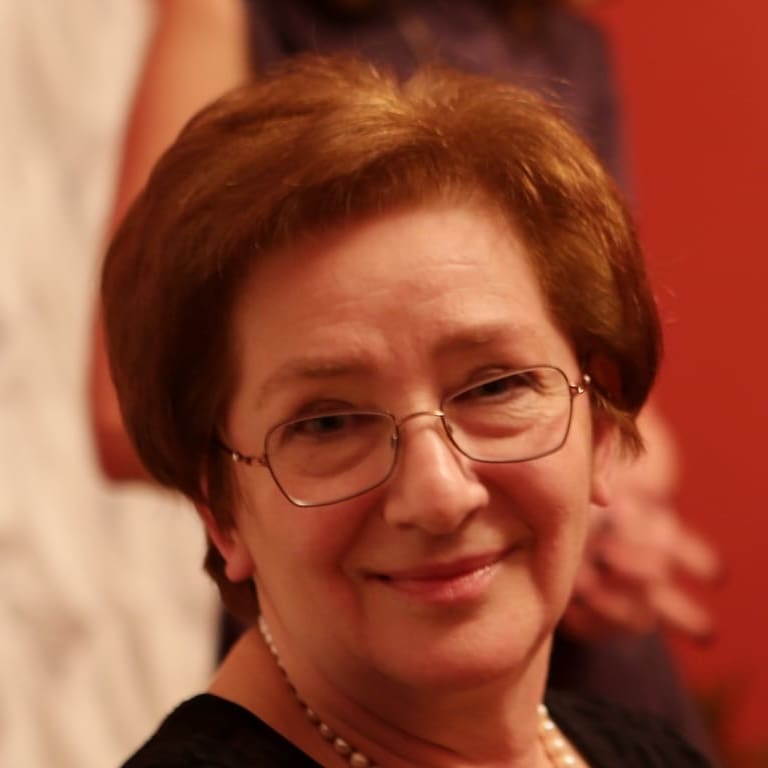
The sad news of Liudmila Kovnatskaya’s death came after a period of difficult communication with our colleagues in Russia. The last time I saw Mila, as all of us called her, was at the celebration of her eightieth birthday, organized online with dozens of participants from around the world, where I represented the IMS with Dorothea Baumann, also a close friend of Mila.
Kovnatskaya was one of Russia’s best known and most respected scholars. She was graduated in 1965 from the Rimsky-Korsakov Conservatoire of Leningrad (today St. Petersburg), where she studied piano, organ (under Isai Braudo), and music history. Her postgraduate training at the same conservatory was supervised by Mikhail Druskin. In 1970 she completed a thesis on Benjamin Britten, and in 1987 she received her doctorate with a dissertation on twentieth-century English music. Kovnatskaya was subsequently appointed professor at the Rimsky-Korsakov Conservatoire and, also in 1987, became a member of the Russian Composers’ Union and served on St. Petersburg’s General Council for Cultural Affairs from 1987 to 1993. An Honored Art Worker of the Russian Federation, Kovnatskaya was also chief researcher at the Russian Institute of Fine Arts History in St. Petersburg. Invitations to lecture abroad included the University of Manchester, the Ural Conservatoire in Yekaterinburg, and the Aldeburgh Festival in the United Kingdom.
Kovnatskaya’s scholarly production is impressive in quantity and importance. Her early work, which includes a book on Britten written in Russian (Moscow, 1974) and a second book on English music in the twentieth century (Moscow, 1986), brought her international renown. Her research on the history of Russian music and musicology also became an important dimension of her work. Several volumes were devoted to Dmitri Shostakovich (studies and materials) and to several other Russian composers and musicologists, including her own teachers, Braudo and Druskin. On Druskin, still in progress, she collected, studied, and published his complete works in several volumes that included recollections and correspondence. Her monumental work, entitled “Ideological Control of Musical Avant-Garde of 1920s: Leningrad Association of Contemporary Music in Reports and Other Materials” and sponsored by George Soros’s Open Society Foundation (1997–99), remains unpublished.
Fluent in English, Kovnatskaya collaborated as consultant on the coverage of Russian music with Stanley Sadie’s second edition of The New Grove Dictionary of Music and Musicians, published in 2001. In 2002 she received the Belyaev medal and literary prize for Arnold Schönberg: Correspondence (St. Petersburg, 2001), and her three-volume edition of Shostakovich at the Leningrad Conservatory: 1919–1930 was awarded the 2013 Book of the Year Award (Music Review). In 2013, she was named “Person of the Year” (Music Review), and in 2016 she received the Resonance Prize from the Diaghilev Festival in Perm for her contribution to the development of music and theater criticism. From 1988 onward, she was active as an organizer of music festivals and events, devoting her efforts especially to the dissemination of English music in Russia and Britten’s in particular, which until then had remained largely unknown.
Kovnatskaya was elected as Russian representative to the IMS Directorium in 2002, during the 17th Quinquennial IMS Congress in Leuven, the same year I was elected to the Directorium as a representative of Italy. Immediately after this election, she proposed the publication in Russian of the proceedings of the IMS Study Group “Cantus Planus” session presented at that congress, a project she completed in 2004.
In 2005, Mila published the article titled “From the History of IMS” in the Russian journal Musicus (vol. 4 [2005]: 19–20), and, also in 2005, she invited the Directorium to St. Petersburg for the Intercongressional IMS Symposium on “Russian Musicology in the Context of Today’s Developments in the Discipline.” During this conference, she presented the initiative of founding the IMS Regional Association for Eastern Slavic Countries, as well as the IMS Study Groups “Stravinsky: Between East and West” and “Shostakovich and His Epoch.” The regional association and the two study groups held their first meetings in Kiev (2008) and subsequently in Minsk (2009) and Petrozavodsk (2011). Since that decade, Mila became a beloved and familiar figure at IMS conferences and events. Among many others, we want to remember here the memorable conference of the IMS Regional Association for Eastern Slavic Countries in St. Petersburg in 2015 on “Working on Composers’ Collected Works,” which again involved the two study groups devoted to Shostakovich and Stravinsky. The event reached international frenzy with the news, presented by Natalia Braginskaya, that the presumed lost manuscript score of Stravinsky’s Funeral Song had been found in the St. Petersburg Conservatory Library.
After 2005 I met Mila on several occasions, three times in St. Petersburg, and also in Kiev, Zurich, Vilnius, Rome, and other places. In addition to her recognized role as an expert on Britten and twentieth-century British music, Mila’s pedagogical commitment strongly contributed to training several generations of musicologists in Russia, some of whom are now recognized internationally. She introduced me to some of her best former students, including Olga Manulkina, the first Russian specialist on Western Baroque music, who presently is teaching at Bard College in Annandale-on-Hudson, New York.
Dear Mila, I won’t be able to forget, besides your tireless activity, your smile and the sweetness of your gaze. We will miss you so much.
Dinko Fabris